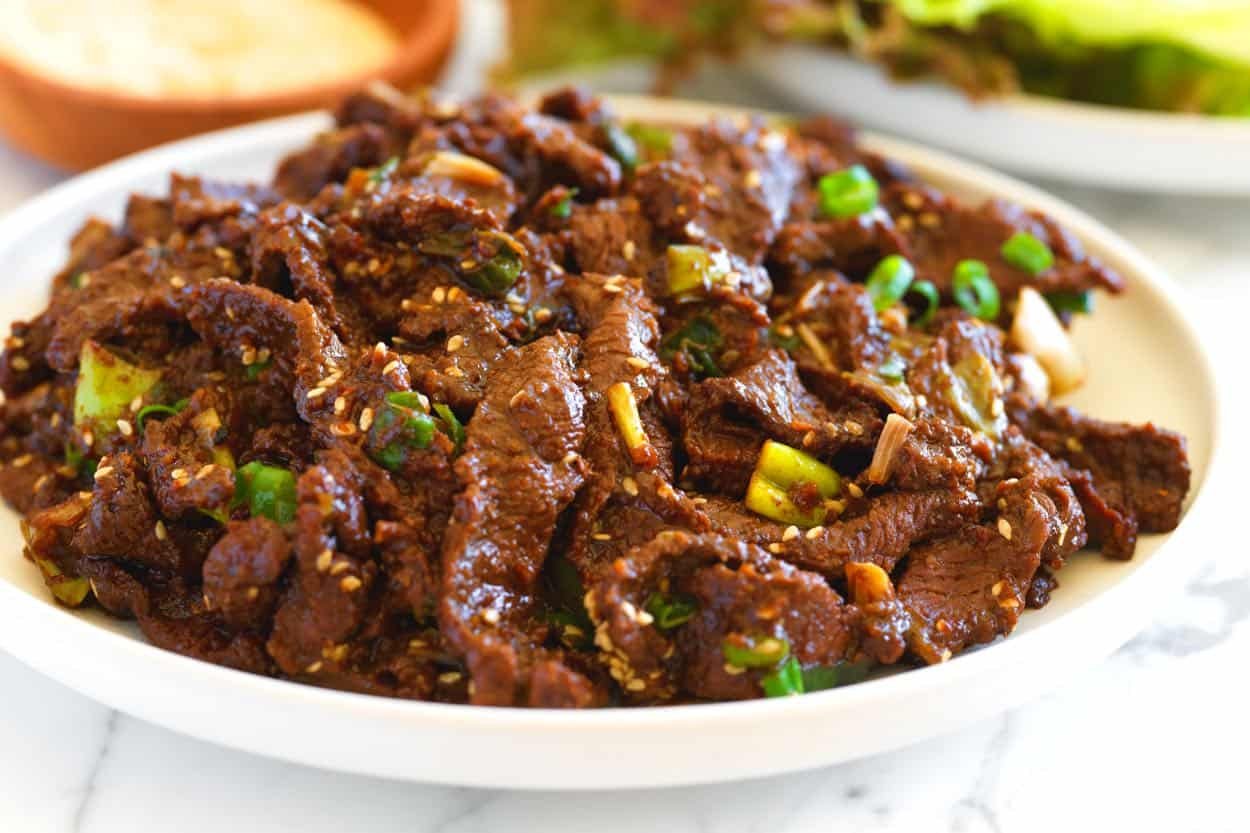
With our bulgogi recipe, you may simply make unbelievable Korean barbecue beef at house. Due to our bulgogi marinade, the meat seems completely candy, savory, and melt-in-your-mouth tender.

Our love for Korean meals started years in the past when Adam’s finest good friend married a Korean-American who proudly launched us to his heritage. He cooked for us and took us to genuine eating places. We fell in love. In the identical manner we take into account pho to be a gateway to Vietnamese meals, bulgogi is the right entry level for anybody trying to discover Korean delicacies.
In case you’ve not had it earlier than, bulgogi is thinly sliced beef that’s been marinated in a savory-sweet soy-based sauce. Then, it’s shortly seared or grilled (it’s really scrumptious!). This straightforward recipe is our go-to once we need to convey the flavors of a Korean barbecue into our personal kitchen, and fortunately, it’s utterly doable for you, too!
Key Components
- Beef: You need thinly sliced beef, which, after marinating, cooks shortly and seems actually tender. Prime sirloin, ribeye, or actually any prime beef minimize works effectively.
- Soy Sauce: That is the bottom of our bulgogi sauce. I like utilizing a low-sodium soy sauce and generally substitute low-sodium tamari. Each work effectively.
- Rice Wine Vinegar: Search for unsweetened rice vinegar (normally with a inexperienced bottle cap or label).
- Sesame Oil: Toasted sesame oil provides a beautiful, toasty, wealthy taste to the meat.
- Brown Sugar and Honey: We actually love each for this. You need to use both one, however the mixture makes our beef style extra attention-grabbing and sophisticated. The honey additionally caramelizes superbly.
- Gochugaru and Black Pepper: This brings a little bit warmth – not a lot although! Bulgogi normally isn’t very spicy. In case you are unfamiliar, gochugaru is Korean chili pepper and is bought as floor pink pepper, to not be confused with gochujang, which is a paste. We use gochugaru when making selfmade kimchi.
- Garlic and Ginger: I all the time use recent garlic. For the ginger, you should purchase ginger root, or some shops promote ginger puree (both refrigerated or frozen).
- Pear: That is the “secret” ingredient. It provides sweetness and comprises pure enzymes that tenderize the meat. Search for Asian, Korean, or Nashi pears. In case you can’t discover them, a ripe Bosc pear or Anjou pear is an efficient substitute.
- Sesame Seeds and Inexperienced Onions: These present texture, colour, and a little bit of freshness on the very finish.
- Lettuce, Rice, and Sides: To make it a full meal, serve with steamed rice and lettuce leaves for wrapping. Don’t overlook the banchan (sides) like kimchi or spicy cucumber salad, and ssamjang (a savory dipping sauce that ties all the pieces collectively).
Discover the complete recipe with measurements beneath.

The best way to Make Bulgogi at Dwelling
Tip 1: Thinly slice the meat. The explanation bulgogi is so laborious to cease consuming is that it seems so splendidly tender. That’s because of the marinade and to the truth that we begin with skinny slices of beef.
The very best trick for getting completely skinny slices is to position your beef within the freezer for 20 to half-hour to agency up a bit. Then, take away it, set it onto your chopping board, and make skinny slices throughout the grain. Slicing throughout the grain breaks up robust muscle fibers, serving to the meat prove extra tender. You don’t must be 100% good; the slices will be ragged and ranging in measurement.
Tip 2: Use a meals processor to make the marinade. In case you don’t have a meals processor, you may make this marinade by hand, however a meals processor makes actually fast work of it. I simply toss all the pieces in and hit pulse till principally easy. In case you’re doing it by hand, you’ll finely grate the garlic and ginger with a microplane, then grate the pear with a field grater.
Tip 3: Marinate for a minimum of 4 hours. Each time I marinate beef, I normally do it in a single day, which might be good for this recipe. That stated, when you’re sitting there within the morning and need bulgogi for dinner, you may completely make that occur. 4 hours provides the pear and different bulgogi sauce substances sufficient time to taste and tenderize the meat.

Tip 4: Cook dinner it shortly. At a Korean barbecue restaurant, there’s typically a grill proper in the midst of the desk the place you may shortly sear/grill the meat. At house, I exploit a heavy-bottomed pan (cast-iron is good) over medium-high warmth, add a little bit oil, then prepare dinner the meat in batches so there’s one layer of beef within the pan at a time (stacking heaps in will steam the meat slightly than caramelize and brown the meat).
Use tongs to tug the marinated beef out of the marinade, then prepare dinner. Some marinade will stick with the surface of the meat, however don’t pour any further into the skillet. You need to sear and caramelize the meat in batches slightly than boiling it within the sauce.

My Favourite Strategy to Serve Bulgogi
The only method to serve that is over rice, however I actually love making lettuce wraps. Take a bit of lettuce (pink leaf or butter lettuce works rather well), add a small spoonful of cooked rice, and place a bit of the new bulgogi on high. End with some kimchi and ssamjang (when you have them available), fold it up, and luxuriate in. It’s tremendous flavorful, has a beautiful mixture of textures, and actually simply makes you need to go in for extra! This beef additionally makes unbelievable tacos (not conventional, however scrumptious nonetheless!).
Extra Scrumptious Beef Recipes

Beef Bulgogi (Korean BBQ Beef)
-
PREP
-
COOK
-
TOTAL
Our Korean-inspired bulgogi recipe is totally doable so that you can make at house. The key to that mouthwatering, tender beef is to thinly slice it throughout the grain to interrupt up the connective tissue, then marinate it in our savory-sweet soy-based marinade for a minimum of 4 hours (in a single day is even higher).
That is beautiful over steamed rice, added to salads, become tacos, or made into lettuce wraps. We extremely advocate serving a aspect of kimchi and ssamjang. You should purchase kimchi or make it utilizing our kimchi recipe. Ssamjang is a spicy dipping sauce bought close to gochujang in Korean markets or extra internationally pleasant grocery shops. You may also discover it on-line.
6 Servings
You Will Want
2 kilos high sirloin or ribeye (907g)
½ cup low-sodium soy sauce or tamari (118ml)
2 tablespoons brown sugar
2 tablespoons rice wine vinegar
1 tablespoon sesame oil
3 tablespoons honey
1 teaspoon floor black pepper
¾ teaspoon gochugaru (Korean chili powder)
4 cloves garlic, smashed
1 ½ inch piece recent ginger, peeled and roughly chopped into ¼ inch items
1 Asian pear, peeled, cored, and minimize into 1-inch items
1 bunch inexperienced onions, trimmed and thinly sliced
1 tablespoon sesame seeds
3 tablespoons high-heat cooking oil, like avocado oil
Lettuce leaves, steamed rice, kimchi, and ssamjang (Korean dipping sauce), non-obligatory for serving
Instructions
1Partially freeze the meat: Place the meat within the freezer for 20 to half-hour to agency up. This makes thinly slicing it a lot simpler. Don’t depart it for much longer, or it would turn out to be too laborious to slice safely.
2Make the marinade: Whereas the meat chills, put together the marinade. Add the soy sauce, brown sugar, rice wine vinegar, sesame oil, honey, black pepper, gochugaru, smashed garlic cloves, roughly chopped ginger, and chopped pear to the bowl of a meals processor. Pulse till you not see giant bits of garlic, ginger, or pear.
3Slice the meat: Take away the meat from the freezer and thinly slice throughout the grain, not more than ¼ inch thick. If some are thinner or extra scraggly, it’s high quality.
4Marinate: Add the sliced beef to a nonreactive bowl (glass or stainless-steel) and pour the marinade over it. Toss effectively, then press a sheet of plastic wrap or parchment paper instantly onto the meat to forestall oxidation. Cowl the bowl with foil or extra plastic wrap and refrigerate for a minimum of 4 hours and as much as in a single day.
5Cook dinner: Warmth a large, heavy-bottomed skillet over medium-high warmth with a tablespoon of oil. Working in batches, raise the meat from the marinade, shaking off any extra liquid, and place it within the pan in a single layer. Sear with out transferring for 1 to 2 minutes, then flip and prepare dinner till caramelized and charred across the edges. Switch to a plate and repeat with the remaining beef.
6To complete: As soon as all the meat is cooked, return all of it to the pan. Add the inexperienced onions and sesame seeds, tossing for about 30 seconds till the onions simply start to wilt. Serve instantly.
Adam and Joanne’s Suggestions
- Storing: Hold leftovers in an hermetic container within the fridge for as much as 4 days. Reheat in a skillet over medium warmth.
- No meals processor: A meals processor makes the marinade come collectively in seconds. In case you don’t have one, simply use a microplane for the garlic and ginger and a field grater for the pear.
- Pear substitutes: In case you can’t discover an Asian pear (generally known as Korean pear or Nashi pear), substitute a ripe Bosc pear or Anjou pear.
- Leftover marinade: For the reason that marinade has touched uncooked meat, you both must discard it or prepare dinner it completely. Pour the remaining marinade right into a small saucepan. Convey it to a rolling boil. You have to maintain it at a boil for two to five minutes (this kills any micro organism from the uncooked meat and reduces the liquid right into a syrupy bulgogi sauce). You might be on the lookout for the sauce to achieve 165°F (74°C).
- The vitamin info offered are estimates.
Diet Per Serving
Serving Measurement
1/6 of the recipe
/
Energy
356
/
Whole Fats
15.5g
/
Saturated Fats
3.4g
/
Ldl cholesterol
89.4mg
/
Sodium
650.2mg
/
Whole Carbohydrate
18.2g
/
Dietary Fiber
1.3g
/
Whole Sugars
14.2g
/
Protein
35.9g